Santa Cruz County Rail Track Removal for A Trail: Unnecessary, Fiscally Irresponsible
Introduction
The Santa Cruz County Regional Transportation Commission (SCCRTC) faces a critical decision regarding the Mid-County Rail-Trail Project. Cost overruns exceed the state’s Active Transportation Program (ATP) grants for the six-mile section between the San Lorenzo River and Aptos.
At the SCCRTC full commission meeting on December 4, 2025, Santa Cruz Mayor Keeley and County Supervisor Koenig brought forward a motion to remove the railroad tracks and build a trail on the railroad grade, allegedly to address the funding shortfall for the trail.
Unfortunately, SCCRTC adopted the Keeley-Koenig motion. However, the Commission also adopted an amendment brought forward by Andy Schiffrin directing SCCRTC staff to concurrently develop an alternative design that would keep the rails intact. TRAC agrees with Mr. Schiffrin’s intention and recommends the alternative outlined in this article and summarized below:
Executive Summary
TRAC recommends that SCCRTC:
- Direct SCCRTC staff to work collaboratively with Roaring Camp and Caltrans Division of Rail to develop a trail design that both meets the ATP grant requirements and supports Corridor ID competitiveness. This design must include track realignment as foundational work and keep the rails in operable condition.
- Accept Roaring Camp’s offer to donate labor for track realignment and refurbishment.
- Utilize asphalt paving for all trail surfaces except where concrete is technically necessary (automotive intersections, potentially bridges). Do not assume flangeway fillers require the use of concrete.
- Implement rubber flangeway filler technology where rail/trail close proximity requires it.
- Place trail beside tracks wherever corridor width permits, after track realignment by Roaring Camp in selected locations, reserving trail-rail overlaps for segments where no other viable option exists.
- Maintain ongoing coordination with the Caltrans Division of Rail throughout the FRA Corridor ID design process to ensure compliance with state rail program requirements and preservation of federal Corridor ID competitiveness.
- Develop a pedestrian safety protocol including speed reductions and horn sounding for those locations where the trail overlaps with the rail.
The updated Rail-With-Trail approach outlined here is an affordable solution that fulfills the Commission’s December 4th directive, respects the will of the supermajority of voters who support rail preservation, and protects eligibility for tens of millions–and possibly hundreds of millions–of dollars in Federal and State matching funding for rail. This approach can deliver the full trail project approved in State Active Transportation Program (ATP) grants within budget, while maintaining the corridor’s viability for future passenger rail service.
Track removal would represent a significant missed opportunity and a reversal of voter intent. It would eliminate federal funding eligibility that far exceeds any perceived savings from tearing out the tracks (even “temporarily”) and realigning the trail on the railroad grade. The engineering challenges facing the project should be addressed through optimized design rather than through elimination of future rail functionality.
If SCCRTC is REALLY committed to infrastructure serving both active transportation with a trail and future public transportation needs, clear Commission direction is required that prioritizes rail preservation while also delivering the long-desired trail project that voters and residents want.
The Case Against Track Removal
In June 2022, an overwhelming majority of voters (73%) voted no on Measure D, Greenway’s trail-only ballot measure, which was intended to eliminate the possibility of rail. Santa Cruz County voters demonstrated overwhelming community support for preserving the rail corridor to enable future passenger service. Passenger rail has been part of several SCCRTC studies and is endorsed by the Santa Cruz County General Plan. Track removal would be contrary to the strong expression of public support for rail, constituting a significant policy reversal with major financial consequences.
Implications for Possible Future Federal Funding for Rail
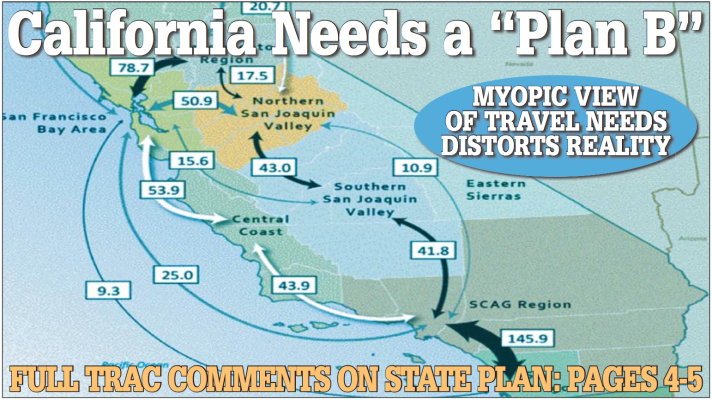
The Santa Cruz County Branch Line has been included as part of the Central Coast Corridor, one of the five California corridors selected for the Federal Railroad Administration’s (FRA) competitive Corridor Identification and Development (Corridor ID) program, to be studied in detail by Caltrans. The Corridor ID program follows a three-step process:
- Step 1 – Scope of Work. This step has been completed, with the corridor promoted by U.S. Representatives Panetta and Lofgren
- Step 2 – Service Development Plan. Beginning in 2026, this step includes value engineering and examining options for phased implementation. This work is 90% federally funded and 10% Caltrans funded. This step is fully funded and is likely to be completed within 18 to 24 months.
- Step 3 – NEPA Environmental Review and 30% Engineering. This step is scheduled to begin in 2029 if approved for development. Capital costs would be 80% federally funded, with the 20% local match to be shared between Caltrans and SCRTC.
At the SCCRTC meeting on January 15, 2026, Rob Cunningham from the Caltrans Office of Rail Planning and Implementation confirmed that Caltrans would continue to sponsor the Santa Cruz line if SCCRTC jurisdiction maintains its commitment to eventual passenger rail service.
However, Mr. Cunnigham pointed out that the FRA would probably reject moving the corridor to Step 3 if the tracks are removed or covered. This means track removal would eliminate any realistic chance of rail service between Watsonville and Santa Cruz, and possible intercity service from the Bay Area. If a project under the FRA Corridor ID program is to become eligible for Federal 80% grants covering final engineering and project construction, the rail corridor must remain intact (i.e., rails, ties, right-of-way, etc.)
TRAC believes that project engineering by the FRA Corridor ID Program will develop realistic capital cost estimates that unmask as preposterous the SCCRTC’s recent estimate of $4.3 billion from the ZEPRT study. (which was 4-5 times the previous SCCRTC study without any clear explanation). The FRA process is less subject to political manipulation since all FRA Corridor ID project engineering and studies must be consistent with FRA’s nationwide, standardized railroad industry cost estimates and study process best practices.
Constructing passenger rail to modern standards between Watsonville and Santa Cruz would be a rather large burden on local taxpayers without Federal and State grants, similar to if local taxpayers needed to cover the near billion-dollar cost of reconstructing Highway 1 currently underway. Losing eligibility for FRA Corridor ID funding would permanently eliminate access to tens of millions of dollars in Federal rail grants (and hundreds of millions in the long run). This potential loss of future grants would dwarf any nominal savings from building a trail on top of the rail bed, as opposed to alongside the tracks.
The Rail-With-Trail Alternative
It is feasible and practical (and responsible) for SCCRTC to deliver the Mid-County trail project without removing or covering the rails. Moving the trail closer to the rail center line in limited-width sections would avoid expensive retaining walls that otherwise would be required.
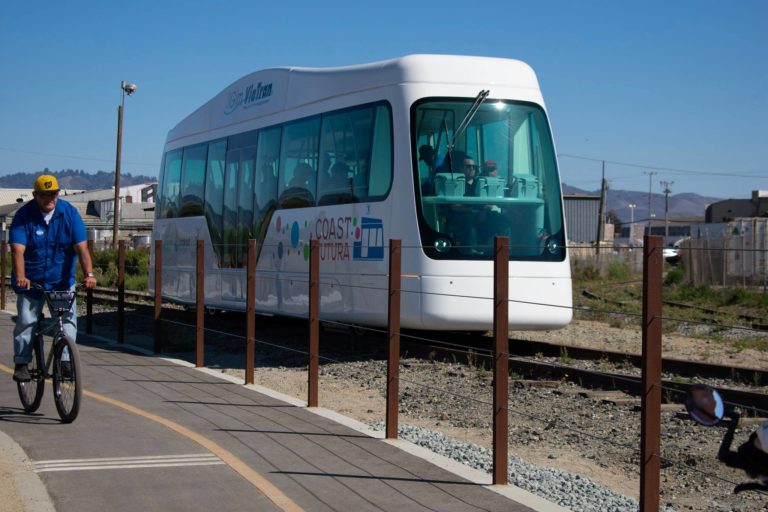
Our associates at Friends of the Rail & Trail (FORT) have developed what they term the “Streetcar Rail-With-Trail” design concept, using proven methods employed on projects elsewhere. It maintains future rail viability at a much lower cost than a future restoration of the rails under the adopted Keeley-Koenig “rip out the rails” alternative.
Key Design Elements:
- Track Realignment and Refurbishment: Santa Cruz County’s excursion train operator, Roaring Camp Railroads, has offered to donate labor for track realignment in selected locations, such as tight locations such as along Park Avenue in Capitola. This offer could save millions of dollars in refurbishment costs compared to full rail and tie replacements, which simply are not needed at this time. This foundational work would create additional space for trail placement in tight locations while simultaneously maintaining the corridor’s ability to accommodate rail. Among other savings, this could help eliminate some of the need for expensive retaining walls in tight locations.
- Rubber Flangeway Fillers: This proven technology, used successfully on several shared rail-trail bridges and at pedestrian-rail intersections worldwide, eliminates gaps between the paving and the rails. They create an ADA-compliant smooth surface anywhere the trail touches or merges with the rails over short stretches, particularly bridges.
This approach has been successfully used by the 700-foot Eureka Slough Rail Bridge and Trail in Humboldt County. It could be applied to some of the existing railroad bridges along the Santa Cruz County rail branch line. Using this option pioneered by Humboldt County would include appropriate safety measures as approved by the California Public Utilities Commission.
- Asphalt Trail Surfaces: Asphalt trails are proven, whether laid over road base or laid flush with rails and flangeway fillers over clean and stable ballast and ties. Asphalt is consistent with interim trail solutions. Concrete roadway rail crossings should be used only where automotive traffic crosses the trail.
- A Flexible Design Toolkit: After track realignment, the corridor width should be assessed on a section-by-section basis, using the following hierarchy:
– Full rail trail separation to established standards when width permits
– Trail placement closer to rails with reduced or modified fencing
– Trail width reduction to 8-10 feet where necessary over short distances
– Connected shoulder design with trail adjacent to rail with flangeway fillers.
– Utilize flangeway fillers where trail and rail overlap in spots with no feasible alternatives, whether retaining or upgrading existing bridges.
Humboldt Bay Trail South: A Tight Rail/Train Solution
The Humboldt Bay Trail South project provides a direct precedent for the Streetcar Rail-With-Trail approach. This 4-mile rail-with-trail project includes a shared 700-foot bridge over Eureka Slough where the trail merges with standard-gauge freight tracks using flangeway fillers for safety and ADA compliance. The project received both CPUC and California Coastal Commission approval and was designed to accommodate excursion rail operations while keeping trail usage of the same structure feasible and safe.
Key features include:
– Trail built parallel to out-of-service freight line except on the bridge
– No fencing between trail and tracks
– Shared rail-trail bridge section with flangeway fillers for safety
– Full CPUC and Coastal Commission approval
– Designed for low-speed rail compatibility (<10 mph)
Documentation for this project is available through Humboldt County Public Works, including the Project Description Report, Coastal Commission adopted findings regarding flangeway filler use, and the Cooperative Use Agreement between the trail sponsor and rail operator.
Engineering Challenges and Realities
Recent site visits to proposed rail-trail segments by engineering teams have identified legitimate engineering challenges for the ultimate trail alignment, including increased water district drainage requirements, the needs for retaining walls, and complications with easements. However, these challenges can be mitigated on an interim basis by bringing the trail closer to the railroad line and using flangeway fillers as needed over short distances, particularly if bridges must be shared. Rail functionality should not be eliminated, but rather the design should optimize and safely serve both rail and trail users.
It should be noted that most of the existing rails on the Santa Cruz County Branch Rail Line are in good condition and would be serviceable with minimal upgrades (replacement ties, ballast and selected rails), except for the varying requirements of bridge work. Selected tie and rail replacement and ballast cleaning can be accomplished quickly and efficiently with specialized machinery, particularly if Roaring Camp’s labor offer is accepted.
When a higher-speed intercity passenger rail project is implemented by the FRA Corridor ID Program, funding will be available to update the rail and trail to wider clearances.
Recommendations
TRAC recommends that SCCRTC:
- Direct SCCRTC staff to work collaboratively with Roaring Camp and Caltrans Division of Rail to develop a trail design that both meets the ATP grant requirements and supports Corridor ID competitiveness. This design must include track realignment as foundational work, and keep the rails in operable condition.
- Accept Roaring Camp’s offer to donate labor for track realignment and refurbishment.
- Utilize asphalt paving for all trail surfaces except where concrete is technically necessary (automotive intersections, potentially bridges). Do not assume flangeway fillers require the use of concrete.
- Implement rubber flangeway filler technology where rail/trail close proximity requires it.
- Place trail beside tracks wherever corridor width permits, after track realignment by Roaring Camp in selected locations, reserving trail-rail overlaps for segments where no other viable option exists.
- Maintain ongoing coordination with the Caltrans Division of Rail throughout the FRA Corridor ID design process to ensure compliance with state rail program requirements and preservation of federal Corridor ID competitiveness.
- Develop a pedestrian safety protocol including speed reductions and horn sounding for those locations where the trail overlaps with the rail.
Conclusion
The updated Rail-With-Trail approach outlined here is an affordable solution that fulfills the Commission’s December 4th directive, respects the will of the supermajority of voters who support rail preservation, and protects eligibility for tens of millions–and possibly hundreds of millions–of dollars in Federal and State matching funding for rail. This approach can deliver the full trail project approved in State Active Transportation Program (ATP) grants within budget, while maintaining the corridor’s viability for future passenger rail service.
Track removal would represent a significant missed opportunity and a reversal of voter intent. It would eliminate federal funding eligibility that far exceeds any perceived savings from tearing out the tracks (even “temporarily”) and realigning the trail on the railroad grade. The engineering challenges facing the project should be addressed through optimized design rather than through elimination of future rail functionality.
If SCCRTC is REALLY committed to infrastructure serving both active transportation with a trail and future public transportation needs, clear Commission direction is required that prioritizes rail preservation while also delivering the long-desired trail project that voters and residents want.
=====================================================================
For more information, contact:
Train Riders Association of California (TRAC)
www.calrailnews.org, president@calrailnews.org (TRAC President) or (916) 557-1667
====================================================================
References and Technical Documentation
– SCCRTC Meeting Minutes, December 4, 2025 (All Commission documents at www.sccrtc.org
– SCCRTC Meeting Minutes, January 15, 2026 (Rob Cunningham, Caltrans Office of Rail Planning and Implementation)
– Federal Railroad Administration Corridor Identification and Development Program Guidance https://railroads.dot.gov/corridor-ID-program
– Humboldt Bay Trail South Project Description Report https://humboldtgov.org/DocumentCenter/View/89042/HBTS-Project-Description-Report-9-9-2020
– Coastal Commission Adopted Findings (Humboldt Bay Trail South): https://humboldtgov.org/DocumentCenter/View/114907/1-20-0560-_-Adopted-Findings
– Santa Cruz County Zero Emission Passenger Rail Project (ZEPRT) Final Project Concept Report, October 24, 2025
– California State Rail Plan, 2018
– (Caltrans) Transit and Intercity Rail Capital Program (TIRCP) Guidelines